- Jun 22, 2026
- 7 min. read
Build vs Buy: When Custom Software Actually Makes Sense

On this page
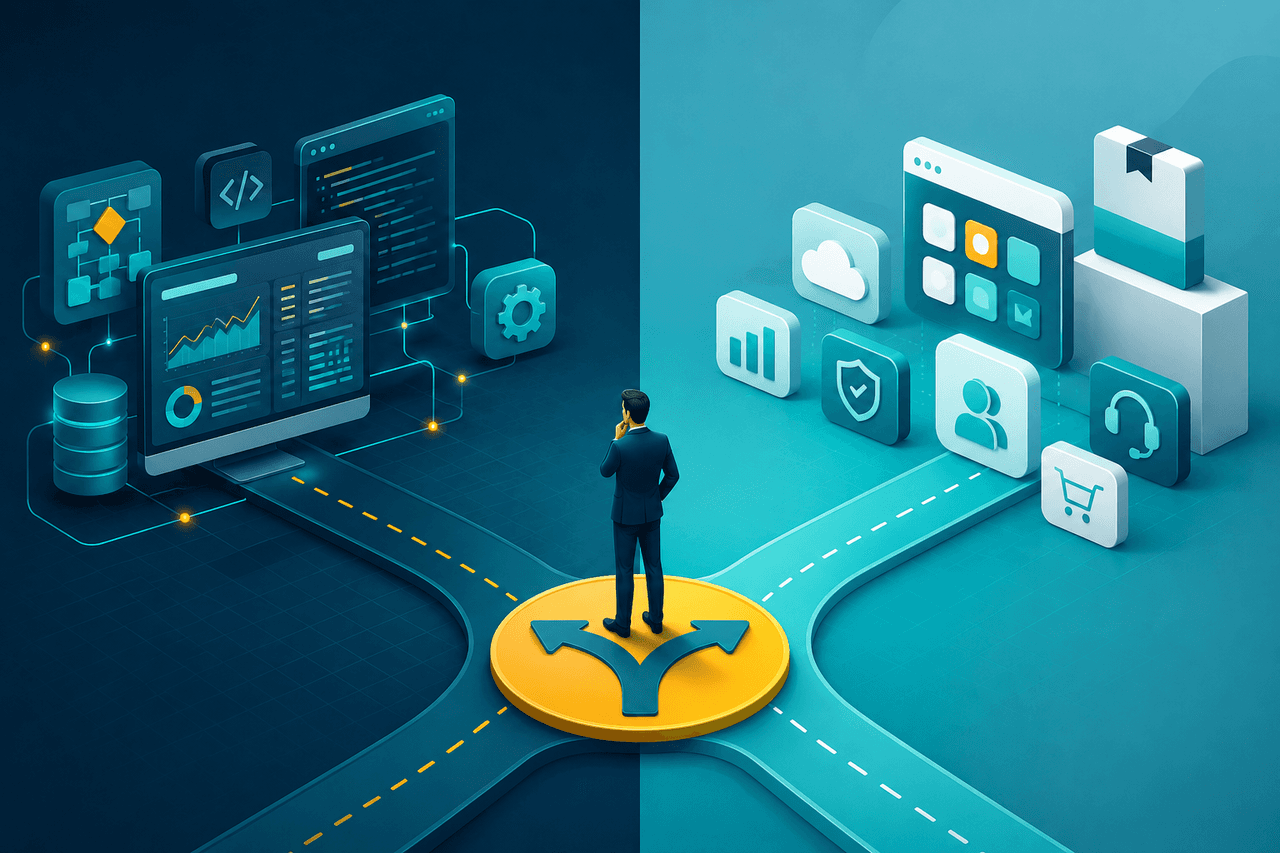
Most organizations eventually face the same question: should we purchase an existing software solution or invest in building something custom?
At first, the decision looks simple. Buying software usually feels faster and safer. Building software usually feels more flexible and specific to the business. But in real operations, the answer is rarely that clean.
The right choice depends on the process, the level of risk, the role the system plays in the business, and the cost of adapting your team to tools that were not designed for your workflow.
What does build vs buy mean?
Build vs buy is the decision between creating a custom software solution and adopting an existing product from the market.
Buying software means using a ready-made platform that already solves a common problem. Building software means designing a system around your specific workflow, data, integrations, users, and business rules.
Both options can be correct. The mistake is assuming that one approach is always better than the other.
Key Takeaway
The goal is not to build software whenever possible. The goal is to choose the option that creates the most business value with the least operational complexity.
Why the decision matters
The wrong decision can be expensive.
Organizations that build too early often spend time and resources recreating functionality that already exists in the market. Organizations that buy the wrong solution frequently discover that teams are spending more time working around software limitations than doing productive work.
This is why the build versus buy decision should not be treated as a technical preference. It is a business decision.
The challenge is finding the balance between speed, flexibility, cost, and long-term value.
When buying software makes sense
In many situations, buying software is the most practical option. Common examples include:
- Accounting systems: Most businesses do not need to build their own accounting platform.
- Payroll software: Payroll rules, taxes, and reporting are usually better handled by specialized products.
- Project management platforms: Many teams can operate effectively with existing tools.
- Customer support systems: Mature products already cover ticketing, help desk workflows, and support communication.
- Marketing automation platforms: Standard campaign management and email workflows are often well covered by existing software.
These functions are largely standardized across industries. The business gains little advantage from building them from scratch.
The faster path to value is often adopting a proven product and focusing resources elsewhere.
Key factors to evaluate before deciding
Before choosing between build and buy, it helps to look at the decision from several angles.
Cost
Buying software often has a lower upfront cost, but subscription fees, seat-based pricing, add-ons, implementation costs, and integration work can grow over time.
Time to market
If the goal is to solve a common problem quickly, buying can be the faster path. If the process is highly specific, custom development may take longer initially but save time later by reducing workarounds.
Flexibility
Off-the-shelf products usually work best when your process fits their model. Custom software works best when the process itself needs to be shaped around your business logic.
Integration needs
Many software problems are not caused by one weak tool. They are caused by disconnected systems. When integration becomes the main challenge, a custom layer can sometimes create more value than another SaaS subscription.
Long-term ownership
Custom software gives more control, but it also creates responsibility. Someone needs to maintain, improve, secure, and support the system over time.
Signs that existing software is no longer enough
As businesses grow, they often encounter warning signs that indicate existing tools may no longer be the best fit.
- Teams maintaining multiple spreadsheets to fill process gaps
- Employees manually moving data between systems
- Repeated exports and imports
- Growing integration challenges
- Inconsistent workflows across departments
- Limited visibility into operational performance
- Processes depending too heavily on a few experienced employees
- Customer experience suffering because internal tools do not support the workflow
When these issues become common, the organization may be paying a hidden operational cost that is larger than the software subscription itself.
Warning Sign
If your team spends more time working around software than working with software, it may be time to reevaluate your approach.
When custom software makes sense
Custom software is most valuable when the business process itself creates competitive advantage. This often happens when workflows are unique, integrations become difficult, manual work becomes expensive, or the process directly impacts revenue.
The workflow is unique
Some organizations operate in ways that standard software was never designed to support. Rather than forcing the business to adapt, custom software can support the process directly.
Integrations become the main challenge
Many businesses do not struggle with individual tools. They struggle with connecting those tools together. Custom software can act as the operational layer that unifies systems and automates information flow.
Manual work creates significant cost
Processes that require large amounts of repetitive manual effort often become strong candidates for automation and custom development.
The process directly impacts revenue
Lead distribution, customer onboarding, lending workflows, sales operations, and customer experience platforms often have a measurable impact on business performance. Small improvements can generate significant returns.
Common mistakes companies make
Build versus buy decisions often go wrong because teams focus only on the initial implementation. The bigger cost usually appears later.
Building too early
If the process is not stable yet, building custom software can lock the business into assumptions that may change quickly.
Buying too many tools
Adding another tool can feel like progress, but it often increases complexity if the new system does not integrate well with the rest of the operation.
Ignoring integration costs
The price of the software license is only part of the cost. Data migration, API work, automation, reporting, permissions, and training all matter.
Underestimating maintenance
Every system needs ownership. Even a well-built custom platform requires updates, monitoring, bug fixes, user support, and ongoing improvements.
A simple framework for evaluating build vs buy
Before making a decision, ask the following questions:
- Is this process central to our business?
- Does it create competitive advantage?
- Are existing solutions creating operational friction?
- Will this process remain important for years?
- Can the expected benefits justify the investment?
- Do we have the right people to maintain the system?
- Will this system need to connect with other tools?
The more yes answers you have, the stronger the case for custom development becomes.
How AI is changing the equation
AI is making custom software more accessible than ever. Projects that once required large development teams can now be built faster and more economically.
This changes the economics of software development. Smaller tools, prototypes, MVPs, workflow automations, and internal systems can now be created with much lower investment than before.
However, AI does not eliminate the build versus buy decision. It simply lowers the cost of building.
Organizations still need to evaluate complexity, risk, maintenance requirements, security considerations, and long-term ownership.
AI can make building faster, but it does not automatically make every system easier to operate, secure, or maintain.
Build vs buy examples
In practice, the decision becomes easier when you compare the type of system being considered.
Usually better to buy
- General accounting software
- Payroll and HR administration
- Basic project management
- Standard email marketing
- Video conferencing
Often worth considering custom development
- Specialized lead management systems
- Custom sales workflows
- Complex customer onboarding
- Workflow automation across multiple systems
- Industry-specific portals
- Operational dashboards connected to multiple data sources
The decision is not about whether software is internal or external. It is about whether the workflow is important, specific, and valuable enough to justify a tailored solution.
There is no universal answer to the build versus buy question. For standardized business functions, buying software is often the most efficient path.
For workflows that create competitive advantage, require extensive integration, or generate significant operational friction, custom software can deliver substantial value.
The most successful organizations do not build everything. They build the things that matter most.
Frequently asked
What is the difference between build and buy software?
When should a company build custom software?
When is buying software the better option?
How does AI affect the build versus buy decision?